

SMSF Property Investment · 2026 Update
Can Your SMSF Still Invest in Residential Property?
New residential LRBAs are gone from 10 August 2026 — but residential property inside super hasn’t disappeared. Here’s what’s changed, and what’s still possible.
SMSF property investment changed significantly on 10 August 2026. An SMSF can no longer enter a new Limited Recourse Borrowing Arrangement (LRBA) to acquire ordinary residential property — full detail on the exact rule is available directly from the ATO’s own explainer on the LRBA changes. Existing LRBAs may continue under the transitional rules, and new LRBAs for eligible business real property remain available.
But that does not mean an SMSF can no longer own residential property. A fund can still acquire residential property outright using available assets, provided the purchase complies with the fund’s investment strategy and the usual superannuation rules. There is also a more sophisticated structure some investors may want to look into — a 13.22C unit trust — which can, in the right circumstances, let an SMSF acquire an interest in a property-owning trust without that trust itself borrowing to buy the property. That distinction matters, and it’s the difference this page walks through.
At a Glance
The question has changed. It’s no longer “can my SMSF borrow to buy a residential property?” — it’s “is there another way to structure residential property ownership between my SMSF and my assets outside super?” That’s where the 13.22C structure comes in.
What Is a 13.22C Unit Trust?
A 13.22C unit trust is a particular type of ungeared related unit trust that, when strict requirements are met, can allow an SMSF’s investment in the trust to be excluded from the fund’s in-house asset rules. The name comes from regulation 13.22C of the Superannuation Industry (Supervision) Regulations, and the conditions — including restrictions on the trust’s own borrowing — must be satisfied both when the SMSF acquires the investment and for as long as it continues to hold it, as set out in the ATO’s ruling on related unit trusts (SMSFR 2009/3). This is not a loophole for indirect SMSF borrowing: the unit trust itself does not borrow to buy the property, which is the fundamental difference from the old residential LRBA strategy.
Put simply: the property is owned by a unit trust, and different investors hold different numbers of units in it. An investor outside super might hold the majority of units, with the SMSF holding a smaller percentage — so the SMSF doesn’t need to own the whole property directly.
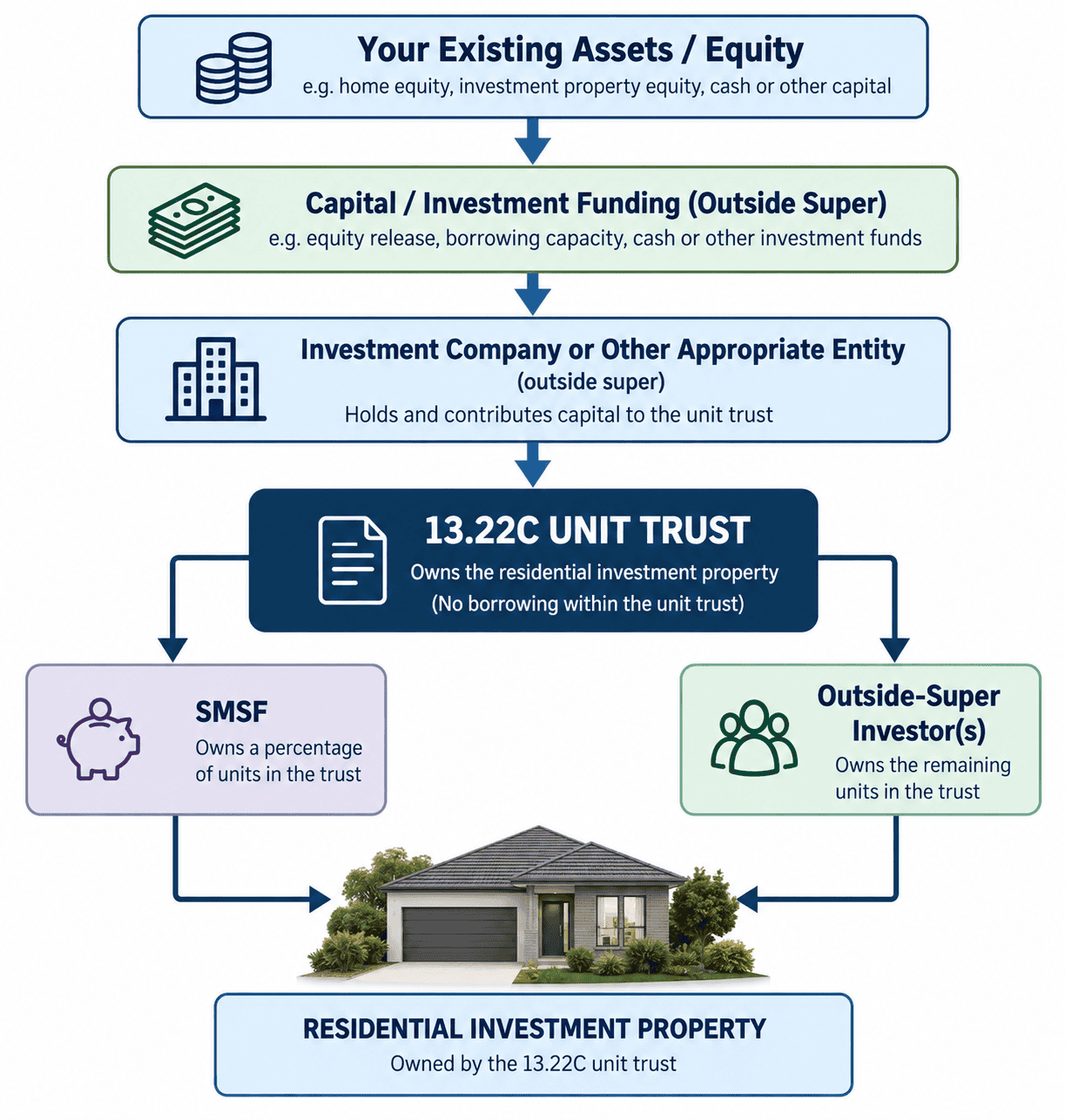
A simplified illustration of how a 13.22C unit trust structure may work — not a recommended ownership structure or financial advice.
How the strategy typically comes together
- Capital outside super. The investor may have equity in their home, existing investment properties, cash, or other capital outside their SMSF. The 13.22C unit trust itself cannot borrow, so any borrowing involved sits outside the SMSF and outside the trust, under a separately structured strategy — a genuinely different proposition from an SMSF LRBA.
- The right entities. Depending on circumstances, the structure may involve an SMSF, a 13.22C unit trust, and an investment company or other entity outside super. Not every investor needs every entity, and each one needs to be set up by qualified financial, tax and legal professionals before anything is implemented.
- The trust acquires the property. The unit trust needs enough capital to buy the property without the trust itself borrowing — typically a mix of capital from outside investors and an amount from the SMSF.
- The SMSF acquires units, not the whole property. Ownership might start at, say, 99% outside super and 1% in the SMSF, or 80/20, or another split entirely — there’s no fixed rule. The right split depends on the investor’s SMSF balance, cash flow, valuation and compliance requirements.
The percentages above are illustrations only, not a recommended starting point.
Can the SMSF Buy More Units Later?
Potentially, yes, subject to the structure continuing to comply. The SMSF may acquire additional units over time — for example starting at 1%, moving to 5%, and later to 20% — gradually increasing its ownership interest in the underlying property as circumstances allow. Each transaction needs to happen at an appropriate, properly documented market valuation, and comply with the relevant superannuation, tax and trust requirements at the time.
Why Might This Suit a Pre-Retiree?
Consider an investor with significant equity outside super who is approaching retirement, wants more property exposure inside their SMSF, but is reluctant to buy another property entirely in their personal name because of the cash flow and tax implications. This structure can let them coordinate ownership outside super with ownership inside it — as the SMSF buys more units over time, a growing share of the investment sits inside the superannuation environment. It’s not about creating a “free” property; it’s about where the ownership sits within the investor’s broader retirement strategy. For investors also weighing up their family home in that picture, the ATO’s downsizer contribution rules are worth understanding too — our sister site has a plain-English guide to super benefits for downsizers.
Rental Income, Growth & Tax
The property stays owned by the unit trust, so rental income flows into the trust and is distributed according to each unitholder’s interest — an SMSF holding 10% of the units receives the economic entitlement attached to that 10%. If the property grows in value and the SMSF later buys more units, those units need to be acquired at an appropriate, independently supportable valuation at the time — never one engineered to manufacture a tax outcome.
Superannuation’s tax treatment is genuinely different from personal ownership, but it isn’t as simple as “SMSF property is taxed at 0%.” The actual outcome depends on the structure used, whether the asset is sold, how long it’s held, whether the fund is in accumulation or pension phase, and the rules applying at the time — the ATO’s own guide to how SMSFs are taxed is the right starting point. Tax should be one factor in the strategy, never the reason for buying a mediocre property.
What About Borrowing Outside Super?
This is a key distinction: the strategy relies on borrowing capacity outside super, not borrowing inside the 13.22C unit trust. An investor might release equity from an existing property through an appropriately structured investment loan, with that capital then forming part of the structure outside the SMSF. Whether that’s appropriate depends on serviceability, existing debt, interest rates, cash flow, tax position and how much change in rates or rental income the investor can comfortably absorb — the same fundamentals that sit behind any use of leverage in a property portfolio.
This Is Not the Old SMSF LRBA Strategy
Under the old residential LRBA, the SMSF itself borrowed to acquire the property. Under a 13.22C structure, the unit trust must not borrow — the SMSF simply acquires units in a trust that owns the property. It isn’t a way of getting around the residential LRBA ban; it’s a genuinely different ownership structure with its own rules, risks and compliance obligations.
What About Commercial Property?
The 2026 changes only affect residential property LRBAs. An SMSF can still use an eligible LRBA to acquire business real property, which is why SMSF commercial property has become a much more prominent strategy this year — particularly for business owners who can lease commercial premises back to their own business on proper terms. The property still needs to genuinely meet the legal definition of business real property; simply calling it “commercial” isn’t enough. If you’re weighing up a residential structure against a straightforward commercial purchase, our sister site’s guide to commercial property investment covers the due-diligence side in more detail.
What Are the Risks?
A more sophisticated structure doesn’t remove investment risk — it adds considerations of its own:
- Structural complexity. Multiple entities, trustees, accountants, auditors and legal documents may be involved.
- Ongoing compliance. The 13.22C conditions must keep being satisfied for as long as the investment is held, not just at acquisition — a later change in circumstances can have real consequences.
- Liquidity. Property is illiquid, and the SMSF still needs to be able to meet its obligations and future benefit payments.
- Borrowing risk outside super. Debt taken on outside the fund remains the investor’s personal responsibility if rates rise, rents fall, or values fall.
- Concentration risk. ASIC specifically highlights the need to weigh diversification, liquidity, risk and likely returns when setting an SMSF’s investment strategy — an SMSF shouldn’t become overly concentrated in a single residential property.
- Cost. Establishment, accounting, auditing, legal, valuation and ongoing compliance costs all need to be justified by the size and suitability of the strategy.
Who Might Consider This — and Who Shouldn’t
A 13.22C structure may be worth investigating for an investor with meaningful super assets, substantial equity or capital outside super, sufficient borrowing capacity where borrowing forms part of the plan, a long investment horizon, and a genuine willingness to get proper legal, tax, SMSF and financial advice before committing.
It’s generally the wrong fit for someone with insufficient capital, an already highly leveraged position, a need for high liquidity, insufficient SMSF assets to justify the cost and complexity, or someone chasing the strategy mainly for a perceived tax advantage. As ASIC’s own guidance makes clear, SMSFs suit some investors and not others, and any recommendation needs to be assessed against the individual’s full circumstances and objectives.
The Property Still Matters
A clever structure can’t turn a poor property into a good investment. The first question shouldn’t be “how do I get my SMSF into this property?” — it should be “is this actually an investment-grade property for my overall strategy?” That still comes down to location, supply and demand, population and employment growth, infrastructure, rental yield, land value, and how the property fits the rest of the portfolio — the same fundamentals our team works through with clients on every residential investment property search. The structure comes after the strategy and the property have both been properly assessed, never before.
Strategy Before Property
At properT network, that’s our whole philosophy — and the 2026 changes make it more important than ever. For one investor the right move is buying residential property outright through their SMSF; for another it’s a 13.22C unit trust; for another it’s commercial property; and for some, an SMSF isn’t the right vehicle at all. Read more about how we apply that thinking on Strategy Before Property.
What Should You Do If You Already Have an SMSF?
- Review your current SMSF position — balance, contributions, investment strategy, existing investments, liquidity and retirement objectives. A property portfolio review is a useful starting point if it’s been a while since you looked at the whole picture.
- Review your assets outside super — available equity, existing debt, borrowing capacity, cash reserves and other investment assets.
- Determine whether property actually makes sense for your objectives, before you start looking at structures.
- Investigate the available ownership structures — direct SMSF ownership, a 13.22C unit trust, commercial property, ownership outside super, or another strategy entirely.
- Get specialist advice to check the legal, tax and SMSF rules before any structure is established or maintained.
- Then select the property to fit the strategy — not the other way around.
The Bottom Line
The 2026 changes have made SMSF residential property investment more complicated, but not impossible. New residential LRBAs are gone from 10 August 2026, but an SMSF can still potentially own residential property without borrowing, and for the right investor a properly structured 13.22C unit trust can offer another way to combine ownership outside super with an SMSF interest in the same property. It’s a more complex approach than the old LRBA strategy and won’t suit everyone — but for the right investor, with the right property and the right advice, it’s worth investigating. The goal was never simply finding a way to buy property through super. It’s finding the right way to structure your entire investment and retirement strategy.
This article is general information only. It is not personal financial, tax or legal advice and shouldn’t be relied on as a recommendation that any particular SMSF, unit trust, company or property structure is right for you. SMSF, tax, trust and superannuation law is complex and can change; a 13.22C unit trust must meet specific legislative requirements, including on an ongoing basis while the investment is held. Professional advice should be obtained from appropriately qualified and licensed financial, tax and legal professionals before establishing or entering any such structure. As ASIC notes in its guidance to the real estate industry, recommendations or opinions about using an SMSF to invest in real property can constitute financial product advice and may require appropriate AFS licensing or authorisation.
Not Sure Which Path Fits Your Fund?
Residential outright, a 13.22C unit trust, or commercial property — the right structure depends on your numbers, not a one-size-fits-all rule.